What Time Is It In Norwegian Time? Understanding Norway's Time Zone
When traveling to Scandinavia or coordinating a business meeting with partners in Oslo, the first question is often: What time is it in Norwegian time? Understanding the temporal alignment of Norway is essential for seamless communication and travel planning.
Norway operates on a single time zone across its entire mainland and island territories. This ensures consistency for government operations, transportation, and commerce throughout the country.
The Standard Time Zone: Central European Time (CET)
Norway follows Central European Time (CET) during the winter months. In technical terms, CET is defined as UTC+1 (Universal Coordinated Time plus one hour). This means that Norway is one hour ahead of London (GMT/UTC) and six hours ahead of Eastern Standard Time (EST) in the United States.
Because Norway shares this time zone with much of mainland Europe, including Germany, France, and Italy, it is easy to synchronize schedules across the continent. If you are attending a livestream or a virtual conference designed for the Central European region, you are effectively operating on Norwegian time.
Daylight Saving Time: Central European Summer Time (CEST)
Like many European nations, Norway observes Daylight Saving Time to make better use of the long summer days characteristic of northern latitudes. During the spring and summer, the country switches to Central European Summer Time (CEST).
- Time Offset: UTC+2.
- When it happens: The clocks typically move forward one hour on the last Sunday of March and move back one hour on the last Sunday of October.
- Impact: During the summer, Norway is two hours ahead of UTC and seven hours ahead of EST.
How to Tell Time in Norwegian
If you are visiting Norway, learning the local vocabulary for time is highly beneficial. While most Norwegians speak excellent English, knowing the basics of the clock can help you navigate local schedules more effectively.
To ask "What time is it?" in Norwegian, you would say: "Hva er klokka?"
When learning to tell time in Norwegian, it is helpful to understand a few key terms and vocabulary related to the clock:
- Klokka: The clock/the time.
- Time: Hour.
- Minutt: Minute.
- Sekund: Second.
- Kvart: Quarter (used for 15 minutes).
- Halv: Half.
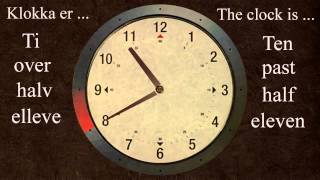
Note on "Half-Past": One of the most confusing aspects for English speakers is how Norwegians express the half-hour. In English, "half past six" means 6:30. However, in Norwegian, "halv sju" literally means "half seven," but it refers to 6:30 (halfway to seven). Always listen carefully to the number mentioned to avoid missing your appointment!
Comparing Norwegian Time to Other Regions
To give you a better perspective of where Norway sits globally, here is a general comparison of Norwegian time (CET) against other major zones:
- New York (EST): Norway is 6 hours ahead.
- London (GMT): Norway is 1 hour ahead.
- Tokyo (JST): Norway is 8 hours behind.
- Sydney (AEST): Norway is 9 hours behind.
Tips for Managing Time Differences
Dealing with time zones can be challenging, especially when planning international calls. To ensure you have the correct time in Norway, consider these tools:
World Clock Apps: Most smartphones have a built-in world clock where you can add "Oslo" to your favorites list for instant updates.
Online