Vocabulary Fractions: Building the Language of Part‑Whole Relationships
Understanding fractions is more than mastering numbers; it is about learning a specific vocabulary that lets students describe parts of a whole clearly and confidently. When teachers talk about fractions, they move through three layers of language: the everyday words of the student, the instructional language of the teacher, and finally the precise language of mathematics. This article explores the key terms, offers practical resources such as videos and songs, and shows how to connect fraction vocabulary to real‑life situations like pizza slices.
Learn the Parts of a Fraction
A fraction is composed of two essential parts:
- Numerator – the number of equal parts being considered.
- Denominator – the total number of equal parts that make up the whole.
For example, in 3/5, the numerator “3” tells us that three pieces are taken, while the denominator “5” tells us the whole is divided into five equal pieces. Teaching students to say “three fifths” or “three over five” helps bridge the gap between symbols and spoken language.
Educational Video to Practice Maths and Reading
Visual and auditory resources reinforce fraction vocabulary. An educational video that combines math practice with reading aloud can be especially effective. In a typical lesson, the presenter might:
- Introduce a familiar object (e.g., a pizza) and label each slice.
- Read a short script that uses fraction terms: “One‑half of the pizza is topped with pepperoni.”
- Pause for students to repeat the phrase, strengthening both math and reading fluency.
Such videos not only demonstrate how to read fractions but also model correct pronunciation, making the language of mathematics more accessible.
When Teaching Math: Three Languages at Play
Effective instruction acknowledges the three distinct languages:
- Student language – everyday words like “part,” “piece,” or “share.”
- Teacher language – instructional phrases such as “simplify,” “convert,” or “compare.”
- Mathematical language – precise terms like “numerator,” “denominator,” “improper fraction,” and “mixed number.”
By explicitly naming each layer, teachers help learners see how a simple idea (“a piece of pizza”) transforms into a formal expression (“three‑quarters of a pizza”). This awareness reduces confusion and encourages students to use the correct terminology.
Learn About Equivalent Fractions
Equivalent fractions represent the same portion of a whole, even though the numbers look different. A quick way to generate equivalents is to multiply or divide both the numerator and denominator by the same non‑zero number.
Examples:
- 1/2 = 2/4 = 4/8
- 3/5 = 6/10 = 9/15
Teaching students to say “one half is the same as two fourths” reinforces the idea that fractions are flexible representations of the same quantity.
A Song to Help Kids Learn About Fractions
Music is a memorable tool for vocabulary acquisition. A simple chorus might go:
“One half, one half, it’s the same as two quarters, One third, one third, three ninths are in order!”Kids can clap the rhythm while pointing to visual aids (e.g., fraction circles). The repetitive lyrics embed terms like “half,” “quarter,” “third,” and “ninth” in a fun, auditory context.
Welcome to Mixed Numbers to Improper Fractions
Mixed numbers combine a whole number with a proper fraction (e.g., 2 ¾). Converting them to improper fractions is a useful skill that reinforces the relationship between whole numbers and fractions.
Conversion steps:
- Multiply the whole number by the denominator.
- Add the numerator to the product.
- Place the sum over the original denominator.
Example: 2 ¾ → (2 × 4) + 3 = 11, so the improper fraction is 11/4. Practicing this conversion helps students learn how to say “eleven fourths” and understand why the value is the same as “two and three quarters.”
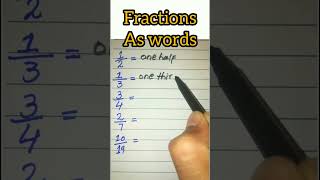
Portion Sizes with Pizza: An English‑Language Learning Video
In a popular English‑language learning video, the host uses pizza to illustrate different portion sizes. The script might include sentences such as:
- “One‑quarter of the pizza has mushrooms.”
- “Three‑eighths of the pizza is left after dinner.”
- “If we share the pizza equally, each person gets one‑third.”
Watching this video allows learners to learn how to say fraction terms in a real‑world context, reinforcing both language and math skills.
Practical Activities for Reinforcing Fraction Vocabulary
Here are three classroom‑friendly activities that combine the ideas above:
- Fraction Card Match – Students match a visual card (e.g., a pizza slice) with a word card (“one‑half”). They then read the phrase aloud.
- Video‑Follow‑Along – After watching a short instructional video, students write down each fraction they hear and draw a corresponding picture.
- Song‑Sing‑Swap – In groups, students create their own verses using a given set of fractions, then perform the song for the class.
Conclusion
Mastering vocabulary fractions equips learners with the language needed to discuss parts of a whole, compare quantities, and solve real‑life problems. By recognizing the three layers of language, using engaging videos, songs, and hands‑on activities, teachers can make fraction terminology clear, memorable, and functional. Whether the context is a pizza slice, a math worksheet, or an English‑learning video, the same core vocabulary—numerator, denominator, half, quarter, mixed number—remains the key to fluency in both mathematics and everyday communication.