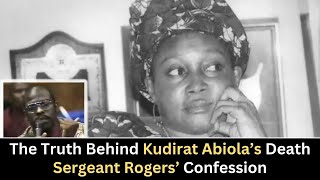
The Sgt Rogers Confession: Uncovering the Truth Behind the Murder of Kudirat Abiola
The assassination of Alhaja Kudirat Abiola remains one of the most contentious and tragic chapters in Nigerian political history. For years, the circumstances surrounding her death were shrouded in mystery and official denials. However, the emergence of testimonies and video clips from the Oputa Panel hearings—specifically the confession of Sergeant Barnabas Jabila Msheila, widely known as Sergeant Rogers—provided a shocking glimpse into the mechanics of the crime.
Who was Sergeant Rogers?
Sergeant Barnabas Jabila Msheila, referred to in many records as Sergeant Rogers, was a member of the Nigerian military. His role became pivotal during the investigations into the murder of Kudirat Abiola, the wife of the late MKO Abiola. As a man positioned within the military hierarchy during a period of intense political instability, Rogers possessed firsthand knowledge of the operations carried out by state security apparatuses.
His testimony is often cited as one of the most critical pieces of evidence because it shifted the narrative from a random act of violence to a calculated state-sponsored execution.
The Oputa Panel Testimony
The Human Rights Violations Investigation Commission, popularly known as the Oputa Panel, was established to investigate gross human rights abuses in Nigeria. It was during these public hearings that the "lost tapes" and testimonies of various military personnel began to surface.
The confession of Sergeant Rogers was particularly shocking. Through his testimony, a detailed account emerged regarding the planning and execution of the hit on Kudirat Abiola. The revelations pointed toward a coordinated effort involving high-ranking military officers, specifically naming Major Amza Al-Mustapha as a central figure in the murder.
The Mechanics of the Crime
According to the accounts provided during the hearings and subsequent analysis of the evidence, the murder was not the work of a lone gunman but a systematic operation. The Sgt Rogers confession highlighted several key points:
- The Planning: The operation was meticulously planned to silence Kudirat Abiola, who had become a vocal critic of the military regime.
- The Execution: The testimony revealed how the assassins tracked the victim and carried out the attack with precision.
- The Command Chain: Rogers’ statements linked the operational orders directly to Major Amza Al-Mustapha, suggesting that the murder was sanctioned at a high level within the military intelligence structure.
The impact of this confession was profound, as it provided a roadmap for how the military regime handled political dissidents and their families during that era.
The Significance of the "Lost Tapes"
For a long time, much of the evidence presented at the Oputa Panel was suppressed or remained inaccessible to the general public. The recovery and release of video clips and transcripts—often referred to as the lost tapes—have renewed interest in the case. These clips serve as a historical record, documenting the moment Sergeant Rogers admitted to the involvement of military personnel in the crime.
For historians and legal experts, these tapes are invaluable. They transform the story from hearsay into a documented confession, providing a factual basis for those seeking justice for the Abiola family.
Historical Legacy and Justice
The case of Kudirat Abiola is more than just a crime story; it is a study of power, impunity, and the struggle for truth in Nigeria. The Sgt Rogers confession stands as a testament to the danger faced by those who challenged the military dictatorship of the 1990s.
While the Oputa Panel provided a platform for these truths to be spoken, the quest for full legal accountability has been long and arduous. The testimony of Barnabas Jabila Msheila remains a cornerstone in the effort to ensure that the historical record accurately reflects the events of December 1999.
Conclusion
The revelations surrounding the Sgt Rogers confession continue to resonate