Using the Pythagorean Theorem on the Coordinate Plane
The Pythagorean Theorem is one of the most fundamental tools in geometry, and its applications extend far beyond simple right triangles drawn on graph paper. When you place a right triangle on the coordinate plane, the theorem becomes a powerful method for finding distances between two points. This approach connects algebra and geometry in a way that makes problem-solving both intuitive and efficient.
Whether you are a student preparing for an exam or someone refreshing their math skills, understanding how to apply the Pythagorean Theorem on a coordinate plane will serve you well. The concept relies on constructing right triangles from any two points and using the relationship between the sides to calculate unknown lengths.
Why the Coordinate Plane Matters
The coordinate plane provides a structured grid where every point is identified by an ordered pair of numbers called coordinates. These coordinates represent the horizontal position (x) and the vertical position (y) of a point. When you are given two points on this plane, you can visualize a straight line segment connecting them. Finding the length of that segment is straightforward when you apply geometric reasoning.
Before the distance formula existed in its modern form, mathematicians relied on the Pythagorean Theorem to solve these problems. That same logical foundation is still used today in classrooms around the world. Courses on Khan Academy are always 100% free, and they provide excellent practice opportunities for students who want to master this topic through guided exercises and video lessons.
Constructing a Right Triangle on the Coordinate Plane
The key step in applying the Pythagorean Theorem on a coordinate plane is to construct a right triangle using the two given points. Here is how the process works in practice:
- Plot both points on the coordinate plane so you can see their exact positions.
- Draw a horizontal line segment from one point to align vertically with the second point.
- Draw a vertical line segment from the other point to meet the horizontal line.
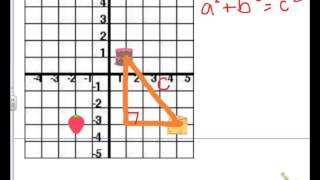
- The hypotenuse of the resulting right triangle is the diagonal line segment connecting the original two points.
This construction creates a right triangle where the horizontal leg represents the difference in x-coordinates, and the vertical leg represents the difference in y-coordinates. The hypotenuse then corresponds to the distance between the two points.
Calculating the Length of a Line Segment
A quick guide to calculating the length of a line segment using the Pythagorean Theorem involves three main steps. First, determine the length of each leg by subtracting the corresponding coordinates. Since distances are always positive, you should take the absolute value of each difference. Second, square both leg lengths. Third, add those squared values together and take the square root of the sum.
Mathematically, this process translates into the well-known distance formula:
- d equals the square root of the quantity (x₂ minus x₁) squared plus (y₂ minus y₁) squared.
This formula is not a separate rule you need to memorize independently. It is simply the Pythagorean Theorem expressed in terms of coordinates. Understanding this connection deepens your grasp of why the formula works and helps you reconstruct it if you ever forget it during a test.
Walking Through a Worked Example
In this short math video we will solve a math problem using the Pythagorean Theorem on the coordinate plane, but you can also work through it on your own. Suppose you need to find the distance between the points (2, 5) and (8, 13). Start by finding the horizontal leg length: subtract 2 from 8 to get 6. Next, find the vertical leg length: subtract 1 from 13 to get 12. Now apply the Pythagorean Theorem by squaring both legs, which gives you 36 and 144. Adding those results yields 180. Taking the square root of 180 simplifies to 6 times the square root of 5, which is approximately 13.42 units.
This example demonstrates that you do not always need a calculator if the numbers simplify nicely. It also shows that even when the result is not a whole number, the method remains reliable and consistent.
Common Mistakes to Avoid
Students often make errors when working with coordinates on the plane. One frequent mistake is subtracting the coordinates in the wrong order and then forgetting to account for negative results. Another common error is forgetting to square the differences before adding them together. Some learners also confuse the order of operations when simplifying the final square root.
To minimize mistakes, always label your points clearly, compute the differences carefully, and double-check your arithmetic before taking the square root. Practicing with a variety of problems builds the confidence needed to avoid these pitfalls.
Real-World Applications
The ability to find distances using the Pythagorean Theorem on a coordinate plane has many practical uses. Architects use similar principles to measure diagonal distances across floor plans. Game developers rely on these calculations to determine spatial relationships between characters and objects. Surveyors and engineers also apply these concepts when translating real-world measurements onto scaled coordinate systems.
By mastering this technique, you are not only learning a geometry skill but also building a foundation for subjects like trigonometry, calculus, and computer graphics.
Getting Started with Practice
If you are looking for additional resources, consider exploring free online courses that focus on geometry and coordinate reasoning. The structured lessons available on platforms like Khan Academy allow you to practice at your own pace and save your progress for future review. Consistent practice with problems of varying difficulty will help solidify your understanding.
The Pythagorean Theorem on a coordinate plane is more than just a formula to memorize. It is a versatile tool that reveals the elegant connection between numbers and shapes. Once you understand how to construct right triangles from any two points, you will find that calculating distances becomes a natural and straightforward process.
```