Mastering Your Punnett Square Practice Worksheet Answer Key
Understanding genetics can feel overwhelming when you first encounter terms like homozygous, heterozygous, and alleles. Whether you are stuck on a specific homework question or preparing for a biology exam, finding a reliable Punnett Square practice worksheet answer guide is essential for mastering the laws of inheritance.
A Punnett Square is a graphical representation used to predict the probability of an offspring inheriting specific traits from its parents. By organizing the parental genotypes, students can visualize the potential genetic combinations of the next generation.
Understanding the Basics of Punnett Squares
Before diving into the answers of a practice worksheet, it is important to understand the terminology used in genetics. Most introductory biology courses focus on complete dominance, where one allele completely masks the effect of another.
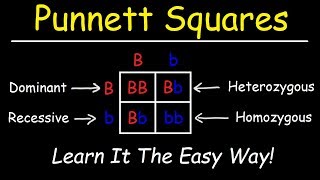
- Dominant Alleles: Represented by uppercase letters (e.g., T). If a dominant allele is present, that trait will be expressed physically.
- Recessive Alleles: Represented by lowercase letters (e.g., t). These traits only appear if the organism possesses two copies of the recessive allele.
- Genotype: The genetic makeup of an organism (e.g., TT, Tt, or tt).
- Phenotype: The physical appearance resulting from the genotype (e.g., Tall or Short).
Step-by-Step Guide to Solving Punnett Square Problems
If you are confused about your homework or stuck on a specific question, following a consistent method will help you arrive at the correct answer every time. Here is a simple process for completing your practice worksheet:
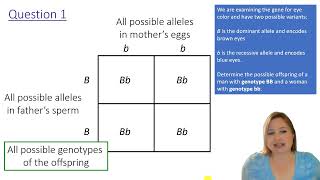
- Identify the Parental Genotypes: Determine the alleles of both parents. For example, if one parent is heterozygous (Tt) and the other is homozygous recessive (tt), these are your starting points.
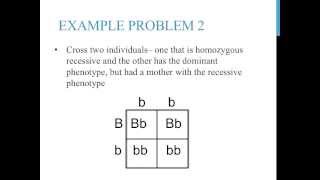
- Set Up the Grid: Create a 2x2 square. Place the alleles of one parent across the top and the alleles of the other parent down the left side.
- Fill in the Squares: Drag the letters from the top and side into the corresponding boxes. For a Tt x tt cross, you would combine the letters to get Tt, Tt, tt, and tt.
- Analyze the Results: Count how many offspring have each genotype and phenotype.
Common Practice Scenarios and Answers
Many biology video tutorials and worksheets focus on these three primary scenarios. Use these as a reference to check your work:
1. Homozygous Dominant x Homozygous Recessive
When crossing TT x tt, every single offspring will inherit one dominant allele and one recessive allele. Answer: 100% Genotype Tt; 100% Dominant Phenotype.
2. Heterozygous x Heterozygous (Monohybrid Cross)
When crossing Tt x Tt, the results are more varied. This is a classic example used in genetics to demonstrate the 3:1 phenotypic ratio. Answer: 25% TT, 50% Tt, 25% tt. Phenotypically, 75% will show the dominant trait and 25% will show the recessive trait.
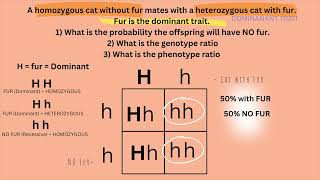
3. Heterozygous x Homozygous Recessive (Test Cross)
When crossing Tt x tt, the offspring are split evenly. Answer: 50% Tt and 50% tt. This results in a 1:1 ratio of dominant to recessive phenotypes.
Tips for Improving Your Genetics Grade
If you find that your answers are consistently different from the answer key, consider these study strategies:
Use Visual Aids: Many students find that biology video tutorials are more helpful than textbooks. Watching a tutor physically draw the square and move the alleles can clarify the process of complete dominance