Proper Nouns Anchor Chart: A Practical Guide for ESL Teachers
Teaching English as a Second Language (ESL) often means finding visual tools that make abstract grammar rules concrete for learners. One of the most effective classroom resources is an anchor chart—a large, reusable poster that students can refer to throughout a unit. When the focus is on nouns, a proper nouns anchor chart helps learners quickly differentiate between general names (common nouns) and specific names (proper nouns). This article explains why a proper nouns anchor chart is essential, how to design one, and how to integrate it into everyday lessons.
Understanding Proper Nouns
Proper nouns are the names of unique people, places, organizations, events, and sometimes objects. They are always capitalized, which signals their specificity. Examples include:
- Paris (city)
- Microsoft (company)
- Thanksgiving (holiday)
- Dr. Patel (person)
In contrast, common nouns refer to general categories—city, company, holiday, doctor. Recognizing this distinction is a foundational skill for reading, writing, and speaking accurately in English.
Why an Anchor Chart Works for ESL Learners
Research on visual learning shows that students retain information better when it is presented both verbally and visually. An anchor chart serves several purposes:
- Reference point: It stays on the wall, so students can glance at it whenever they are unsure.
- Consistent language: The same wording and examples are used across lessons, reinforcing vocabulary.
- Collaborative creation: Involving students in building the chart increases ownership and memory.
- Cross‑curricular link: The chart can be reused in reading, writing, and speaking activities, making it a true “anchor.”
Step‑by‑Step: Building a Proper Nouns Anchor Chart
- Choose a clear title. Write “Proper Nouns vs. Common Nouns” at the top in large letters.
- Define each term. Use concise language:
- Common noun: a general name for a person, place, thing, or idea.
- Proper noun: a specific name that is always capitalized.
- Add visual cues. Use color coding—blue for common nouns, red for proper nouns. Include small icons (a book for “common,” a flag for “proper”) to aid visual learners.
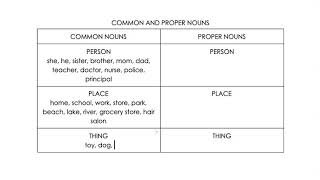
- Provide side‑by‑side examples. Create two columns:
- Common: city, river, teacher, movie
- Proper: Tokyo, Amazon River, Ms. Lee, “Titanic”
- Highlight capitalization. Circle the first letter of each proper noun in a bright color and write a short note: “Always start with a capital letter.”
- Include a quick quiz. Add a small section at the bottom with three sentences where students must underline the proper nouns. This turns the chart into a mini‑assessment tool.
Integrating the Chart into Daily Lessons
Once the chart is up, use it actively:
- Warm‑up activity: Show a sentence on the board and ask students to point to the proper nouns on the chart.
- Reading circles: When reading a short story, have learners mark proper nouns and then compare their markings with the chart.
- Writing prompts: Ask students to write a paragraph about a favorite holiday, then check their work against the chart for correct capitalization.
- Game time: Play “Noun Hunt” where teams race to find as many proper nouns as possible in a magazine spread, then verify each find using the anchor chart.
Sample Content for a “Common Proper Noun Anchor Chart”
Below is a ready‑made list that can be copied directly onto the poster. Feel free to adapt it to the cultural background of your class.
- People: Albert Einstein, Mahatma Gandhi, Queen Elizabeth
- Places: Mount Everest, Sahara Desert, Sydney Opera House
- Organizations: United Nations, NASA, Red Cross
- Events & Holidays: Diwali, Independence Day, Olympic Games
- Brands & Products: Apple, Coca‑Cola, Toyota
Adapting the Chart for Different Age Groups
For younger learners, keep the language simple and use more pictures. For teenage or adult ESL classes, add a column for “proper noun exceptions” (e.g., “e‑mail” vs. “Email” in different style guides) and include short explanations of why some proper nouns can become common nouns over time (e.g., “thermos”).
Digital Alternatives and Hybrid Classrooms
If your classroom uses interactive whiteboards or a learning management system, create a digital version of the anchor chart using tools like Google Slides or Canva. The digital chart can be annotated in real time, shared with remote learners, and saved for future reference.
Measuring Success
Track progress by comparing pre‑ and post‑tests on noun identification. A simple rubric can assess:
- Correct identification of proper nouns.
- Accurate capitalization in writing.
- Ability to explain the difference in their own words.
Improvement in these areas indicates that the anchor chart is serving its purpose as a visual anchor for language acquisition.
Conclusion
A well‑designed proper nouns anchor chart is more than a decorative poster; it is a dynamic teaching tool that supports ESL learners in mastering one of the most visible aspects of English grammar—capitalization. By following the steps outlined above, teachers can create a chart that is clear, engaging, and adaptable to any classroom setting. Use the chart daily, involve students in its creation, and watch confidence in noun usage grow across reading, writing, and speaking activities.