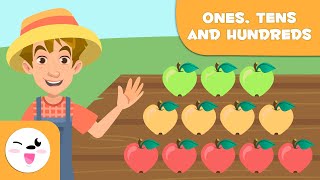
Understanding the Ones, Tens, and Hundreds Chart
For children beginning their journey into mathematics, understanding the concept of place value is a critical milestone. A ones, tens, and hundreds chart serves as a visual map that helps students understand how numbers are constructed and how the value of a digit changes based on its position within a number.
Place value is the foundation of arithmetic. Without a firm grasp of how ones, tens, and hundreds interact, students may struggle with more complex tasks such as multi-digit addition, subtraction, and eventually multiplication. By using a structured chart, learners can move from concrete counting to abstract mathematical thinking.
What is a Place Value Chart?
A place value chart is a graphic organizer used to organize digits into columns. Each column represents a specific power of ten. In a basic three-column chart, the columns are arranged from right to left:
- Ones Column: The furthest right column. It represents individual units (0–9).
- Tens Column: The middle column. Each unit in this column represents a group of ten ones.
- Hundreds Column: The left column. Each unit in this column represents a group of ten tens, or one hundred ones.
For example, if a child looks at the number 352, the chart helps them visualize that there are 3 hundreds, 5 tens, and 2 ones. This prevents the common mistake of seeing the number simply as a string of digits rather than a combined value of 300 + 50 + 2.
How to Use a Ones, Tens, and Hundreds Chart
Teaching place value is most effective when it moves from physical objects to visual representations. Here is a step-by-step approach to using a chart effectively:
- Concrete Manipulation: Use base-ten blocks. Give the student individual cubes for ones, rods for tens, and flats for hundreds. Have them place the physical blocks into the corresponding columns of the chart.
- Visual Representation: Transition to drawing. Instead of blocks, encourage students to draw small dots for ones, lines for tens, and squares for hundreds.
- Abstract Numbering: Once the student understands the physical grouping, introduce the digits. Ask them, "In a random number, can you figure out what the digit in the tens place represents?"
The Importance of "Regrouping"
One of the most challenging concepts for early learners is regrouping, often referred to as "carrying" or "borrowing." A ones, tens, and hundreds chart makes this process logical rather than mechanical.
When a student reaches ten in the ones column, they learn that those ten ones "bundle" together to create one single unit for the tens column. Similarly, when ten units accumulate in the tens column, they regroup to form one unit in the hundreds column. This visual movement helps children understand that the number of items hasn't changed, only the way they are grouped.
Practical Examples for Learning
To reinforce these concepts, try these simple exercises using a place value chart:
Example 1: Decomposing Numbers
Take the number 487. Ask the student to place the digits in the chart.
- Hundreds: 4 (Value: 400)
- Tens: 8 (Value: 80)
- Ones: 7 (Value: 7)
Example 2: Comparing Values
Place the number 251 and 215 side-by-side on two charts. Ask the student which number is larger. By looking at the tens column, they can see that 5 tens (50) is greater than 1 ten (10), even