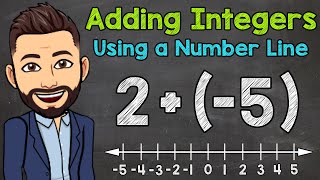
Understanding Number Lines with Negative and Positive Integers
A number line is one of the most fundamental tools in mathematics. It provides a visual representation of numbers, allowing students and mathematicians to understand the relationship between different values. While basic arithmetic often begins with whole numbers starting at zero, mastering number lines with negative and positive integers is essential for progressing into algebra and advanced physics.
What is a Number Line?
At its core, a number line is a straight line where every point corresponds to a number. In a standard horizontal number line, there is a central starting point known as the origin, which is represented by the number zero.
- Positive Integers: These are numbers greater than zero. They are located to the right of the origin. As you move further right, the values increase.
- Negative Integers: These are numbers less than zero. They are located to the left of the origin. As you move further left, the values decrease.
- Zero: Zero acts as the neutral boundary. It is neither positive nor negative.
The Concept of Absolute Value
When working with positive and negative numbers, it is important to understand absolute value. Absolute value refers to the distance a number is from zero, regardless of its direction. Because distance can never be negative, the absolute value is always expressed as a positive number.
For example, both -5 and 5 are exactly five units away from zero. Therefore, the absolute value of both numbers is 5. This concept is critical when calculating the magnitude of a change or the distance between two points on a number line.
Adding Integers Using a Number Line
Adding integers is a process of movement along the number line. By visualizing addition as a series of "jumps," the logic of positive and negative sums becomes clearer.
Adding a Positive Integer
When you add a positive number, you move to the right. For instance, if you start at -2 and add 5, you move five spaces to the right, landing on 3.
Adding a Negative Integer
Adding a negative number is mathematically equivalent to subtracting. When you add a negative integer, you move to the left. For example, if you start at 4 and add -6, you move six spaces to the left, landing on -2.
- Start at the first number (the starting point).
- Determine the direction: Right for positive, left for negative.
- Count the units based on the second number.
- Identify the final position to find the sum.
Subtracting Integers on the Number Line
Subtraction can be confusing when negative signs are involved. The simplest way to handle subtraction on a number line is to treat it as "adding the opposite."
If a problem asks you to subtract a negative number (e.g., 5 - (-3)), the two negative signs effectively cancel each other out, turning the operation into addition (5 + 3). On the number line, this means instead of moving left, you move to the right, landing on 8.
Real-World Applications of Positive and Negative Numbers
Number lines are not just theoretical; they represent many real-life scenarios where values can drop below a baseline of zero.
- Temperature: A thermometer is essentially a vertical number line. Temperatures above zero are positive, while temperatures below freezing are negative.
- Finance: Bank balances use positive numbers to show deposits (money owned) and negative numbers to show debts or overdraws (money owed).
- Elevation: Sea level is the origin (zero). Mountains have positive elevation, while trenches in the ocean have negative elevation.
Summary of Movement Rules
To quickly master the number line, remember these basic movement rules: