Understanding the Number Line by 5
The number line is a foundational tool in mathematics, used to visualize the relationships between numbers. When learning to count, measure, or perform operations, understanding how to skip-count or segment a number line is essential. A number line by 5 refers to a scale where each major tick mark represents an increment of five units. This simple yet powerful visualization helps students grasp multiplication, division, and the concept of multiples.
How to Create a Number Line by 5
Creating a number line by 5 is a straightforward process. Start by drawing a straight horizontal line. Place a mark at the far left and label it zero. From there, draw evenly spaced tick marks moving to the right. Each subsequent mark should increase by five. Your sequence will follow the pattern: 0, 5, 10, 15, 20, 25, and so on.
Consistency in spacing is the most important aspect of drawing your number line. If the distance between 0 and 5 is one inch, the distance between 5 and 10 must also be exactly one inch. This ensures that the physical length on the paper accurately represents the numerical value, providing a clear spatial understanding of how these values grow.
Applications of Skip Counting by 5
Using a number line by 5 is the primary method for teaching skip counting. Skip counting is a precursor to multiplication. When you jump from 5 to 10, then to 15, you are essentially performing repeated addition. This visual aid allows students to see that 15 is three jumps of five, which is the geometric equivalent of 3 x 5 = 15.
Beyond basic arithmetic, this skill is vital for practical tasks such as:
- Telling Time: Analog clocks use increments of five minutes around the face. Recognizing the number line by 5 helps children translate the position of the minute hand into time.
- Counting Currency: Many coin systems, such as the nickel in the United States, rely on increments of five.
- Data Interpretation: Graphs often use intervals of five on the y-axis to represent larger data sets efficiently.
Fractions and the Number Line
While a number line by 5 often refers to whole numbers, the concept is also critical when working with fractions. For instance, when you need to represent 3/5 on a number line, you must first divide the space between 0 and 1 into five equal segments. Each segment represents one-fifth (1/5). By counting three of these segments, you arrive at the 3/5 mark.
This demonstrates that the number line is not just for counting by fives; it is a flexible tool that can be subdivided into any unit. Understanding how to divide a single unit into fifths prepares students for more complex operations, such as comparing fractions or adding values with different denominators.
Advanced Representations: Roots and Beyond
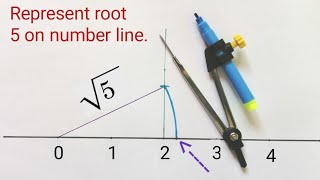
Number lines are not limited to integers or simple fractions. In more advanced mathematics, students learn to represent root values on a number line. For example, plotting the square root of a number requires using the Pythagorean theorem to determine the exact distance from zero. While this is significantly more complex than skip-counting by five, the underlying principle remains the same: every number, regardless of its type, has a specific, fixed position on the infinite line.
Tips for Mastering Number Line Skills
To become proficient with number lines, consider these practice strategies:
- Use Graph Paper: The pre-printed grid lines make it much easier to maintain consistent spacing between your increments of five.
- Label Clearly: Always start your number line with zero and clearly mark the increments. If you are working with large numbers, consider using a break symbol (a zigzag line) to start your number line at a higher value, such as 50 or 100.
- Interactive Learning: