Transforming Your Space: Creative Mathematics Classroom Decorations
Creating an engaging learning environment is essential for student success. When it comes to mathematics classroom decorations, the goal is to balance aesthetic appeal with educational utility. A well-decorated math room does more than just look good; it serves as a "third teacher," providing students with visual cues, formulas, and inspiration that reinforce daily lessons.
Whether you are a new teacher setting up your first room or a veteran educator looking to refresh your space, integrating functional decor can reduce math anxiety and foster a growth mindset.
Why Visual Aids Matter in Math
Mathematics is often abstract. By bringing concepts into the physical space through decorations, teachers can help students visualize complex ideas. Visual aids serve several purposes:
- Quick Reference: Posters with formulas or multiplication tables allow students to find answers independently.
- Concept Reinforcement: Seeing a geometric theorem every day helps with long-term retention.
- Reducing Anxiety: A colorful, welcoming environment makes a challenging subject feel more approachable.
Creative Number Decoration Ideas
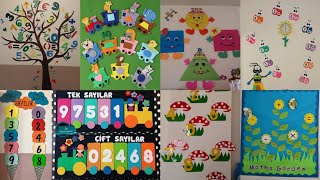
For primary and elementary levels, focusing on number learning is key. Number decoration ideas should be tactile, bright, and interactive. Consider these approaches to make numbers pop:
1. Interactive Number Lines
Instead of a standard printed strip, create a 3D number line. Use colorful ribbons, hanging beads, or floor decals. This allows students to physically move along the line to understand addition and subtraction.
2. The "Number of the Day" Station
Dedicate a section of your wall to a dynamic display. Each day, feature a specific number and surround it with its properties: is it prime or composite? What is its square root? How is it written in binary? This keeps the decor fresh and the students curious.
3. Geometric Wall Art
Use Washi tape to create large-scale geometric shapes directly on the walls or ceiling. You can create a tessellation pattern or a giant coordinate plane. This transforms the architecture of the classroom into a living textbook.
Essential Math Decor Categories
To ensure your room is balanced, categorize your decorations into three main types: instructional, motivational, and interactive.
Instructional Displays
These are the "must-haves" that support the curriculum. Focus on:
- Formula Cheat Sheets: Large, clear prints of the Pythagorean theorem, area formulas, or quadratic equations.
- Vocabulary Walls: A word wall featuring terms like hypotenuse, coefficient, and integer.
- Conversion Charts: Quick-glance guides for metric to imperial measurements.
Motivational Elements
Math can be intimidating. Use your walls to build confidence. Instead of just "Math is Fun," try quotes that emphasize persistence, such as "Mistakes are proof that you are trying." Displaying a "Famous Mathematicians" gallery—featuring diverse figures from around the world—can also inspire students to see themselves in the field.
Interactive Zones
Get students involved in the decoration process. Create a "Problem of the Week" board where students can pin their solutions. Use a chalkboard or whiteboard section specifically for "Math Doodles," where students can draw patterns or fractal art.
Tips for an Organized Math Classroom
While it is tempting to fill every inch of wall space, too much visual noise can be distracting. To keep your math classroom decoration ideas effective, follow these guidelines:
- Use a Consistent Color Palette: Choose 2-3 primary colors to keep the room feeling cohesive rather than chaotic.
- Leave White Space: Ensure there are "quiet" areas on the walls to prevent sensory overload.
- Rotate Content: Change your posters based on the current unit. If you are teaching fractions, move the geometry