Mastering Math Operations Keywords: A Guide to Identifying Word Problems
For many students, the most challenging part of mathematics is not the calculation itself, but the translation of language into numbers. Word problems require a specific skill set: identifying the correct mathematical operation based on the terminology used. By understanding math operations keywords, students can bridge the gap between reading a scenario and solving an equation.
Join us as we discuss the different keywords associated with the four primary operations—addition, subtraction, multiplication, and division—and how to recognize them in various contexts.
The Role of Keywords in Mathematics
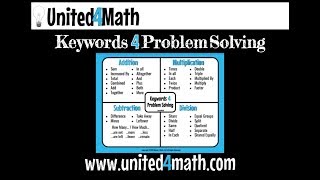
Keywords act as signals. When a student encounters a word problem, these terms provide a hint about which process to apply. However, it is important to note that keywords are tools for guidance, not absolute rules. While "total" often suggests addition, the context of the problem always dictates the final operation. Developing a strong vocabulary of maths keywords allows learners to approach problems with confidence and precision.
Addition Keywords: Combining Quantities
Addition is used when we combine two or more groups to find a total. When reading a problem, look for words that suggest an increase or a gathering of items.
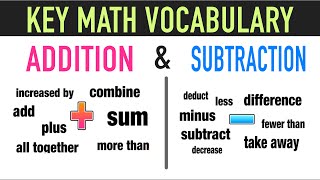
Common addition keywords include:
- Sum: The result of adding two or more numbers.
- Total: The whole amount after combining parts.
- Plus: A direct indicator to add.
- Increased by: Indicates that a value is growing.
- Combined: Bringing two sets together.
- Altogether: Finding the collective amount of all items mentioned.
- More than: Adding a specific amount to an existing value.
Subtraction Keywords: Finding the Difference
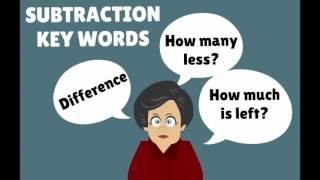
Subtraction is typically used to find what remains after a part is taken away or to compare two different quantities. Identifying subtraction keywords often involves looking for words that imply loss or comparison.
Common subtraction keywords include:
- Difference: The result of subtracting one number from another.
- Minus: A direct indicator to subtract.
- Decreased by: Indicates that a value is shrinking.
- Less than: Subtracting a value from another.
- Remain/Left: Finding what is left after some has been removed.
- How many more: A classic comparison phrase used to find the gap between two numbers.
- Deduct: To take away a specific amount.
Multiplication Keywords: Repeated Addition
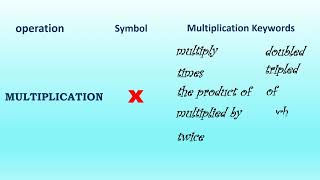
Multiplication is essentially repeated addition. It is used when you have several groups of the same size and need to find the total. These keywords often signal a scaling effect.
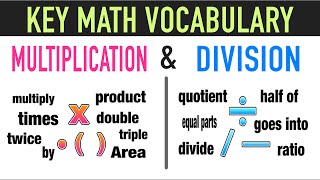
Common multiplication keywords include:
- Product: The result of multiplying two numbers.
- Times: A direct indicator of multiplication.
- Of: Frequently used in fractions or percentages (e.g., "half of 20").
- Twice/Double: Specifically indicates multiplying by two.
- Triple: Specifically indicates multiplying by three.
- Each: When used to describe a group size that is being repeated.
- Per: Often indicates a rate that must be multiplied by a quantity.
Division Keywords: Splitting into Equal Parts
Division is the process of splitting a large group into smaller, equal sections. Keywords for division often focus on sharing or partitioning.
Common division keywords include:
- Quotient: The result of dividing one number by another.
- Divided by: A direct indicator to divide.
- Shared equally: Splitting a total into equal portions.
- Split: Breaking a total into smaller groups.
- Half