Understanding Key Words For Mathematical Operations
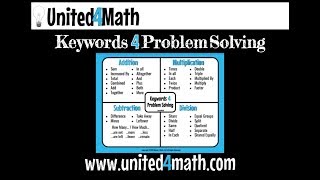
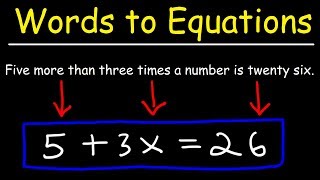
Solving word problems is often one of the most challenging aspects of mathematics for students. While the calculations themselves may be straightforward, the difficulty lies in translating written language into mathematical equations. To bridge this gap, students must identify key words for mathematical operations that signal which process to use: addition, subtraction, multiplication, or division.
Join us as we discuss the different linguistic cues that help learners decode word problems and turn complex sentences into solvable math problems.
Keywords for Addition
Addition is the process of combining two or more amounts to find a total. When reading a problem, certain words act as "red flags" that suggest the need to add. These words typically imply an increase or a gathering of items.
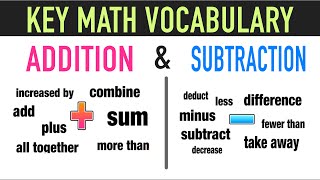
Common addition keywords include:
- Sum: The result of adding numbers together.
- Total: The complete amount after combining parts.
- Plus: A direct indicator to add.
- Increased by: Suggests that a value is growing.
- Combined: Putting two or more groups together.
- Additional: Adding more to an existing amount.
- Altogether: Finding the grand total of all items mentioned.
For example, if a problem asks, "Sarah has 5 apples and Tom gives her 3 more; how many does she have altogether?" the word "altogether" signals that addition is required.
Keywords for Subtraction
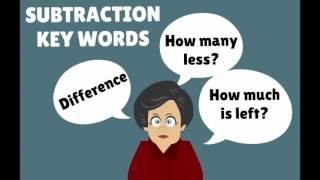
Subtraction is used when finding the difference between two numbers or determining how much is left after a portion has been removed. Subtraction keywords often focus on comparison or reduction.
Common subtraction keywords include:
- Difference: The result of subtracting one number from another.
- Minus: A direct indicator to subtract.
- Decreased by: Suggests a reduction in value.
- Less than: Comparing one amount to another.
- Remain/Remaining: Finding what is left over.
- Deduct: To take away a specific amount.
- How many more: Comparing two quantities to find the gap.
In a scenario like, "There were 20 cupcakes, but the students ate 12. How many remain?" the word "remain" tells the student to subtract 12 from 20.
Keywords for Multiplication
Multiplication is essentially repeated addition. It is used when you have a specific number of equal-sized groups and need to find the total.
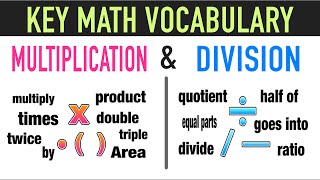
Common multiplication keywords include:
- Product: The result of multiplying two or more numbers.
- Times: A direct indicator of multiplication.
- Of: Often used with fractions or percentages (e.g., "half of 20").
- Twice/Double: Multiplying by two.
- Triple: Multiplying by three.
- Per: When used to find a total based on a unit rate.
- Each: When the goal is to find the total of multiple identical groups.
If a problem states, "Each box contains 6 pencils; how many pencils are in 4 boxes?" the word "each" combined with the need for a total indicates multiplication.
Keywords for Division
Division is the process of splitting a large group into equal smaller groups or finding how many times one number fits into another.
Common division keywords include:
- Quotient: The result of a division problem.
- Divided by: A direct indicator to divide.
- Split: Breaking a total into equal parts.