How To Play Sudoku: A Beginner's Guide to the Logic Puzzle
Sudoku is one of the most popular logic-based number-placement puzzles in the world. Despite its appearance, it does not require any mathematical skills, addition, or multiplication. Instead, it relies entirely on deductive reasoning and pattern recognition. Whether you are picking up a puzzle book for the first time or using a digital app, learning the rules is the first step toward mastering this brain-teasing game.
The Basic Layout of a Sudoku Grid
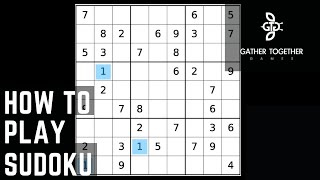
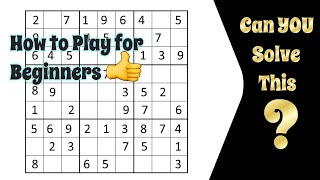
A standard Sudoku puzzle consists of a large 9x9 grid. This grid is further divided into nine smaller 3x3 sub-grids, often referred to as "blocks," "boxes," or "regions."
When you start a game, some of the cells in the grid are already filled with numbers. These are called given numbers. Your objective is to fill the remaining empty cells so that every number from 1 to 9 appears exactly once in three specific areas:
- Each Row: Every horizontal line must contain the numbers 1 through 9 without repetition.
- Each Column: Every vertical line must contain the numbers 1 through 9 without repetition.
- Each 3x3 Block: Every smaller square region must contain the numbers 1 through 9 without repetition.
Step-by-Step Instructions for Beginners
If you are new to the game, the prospect of a blank grid can be intimidating. The key to success is to look for the most restricted areas first. Here is a simple process to get you started:
1. Scanning for "Low Hanging Fruit"
Start by scanning the rows, columns, and blocks to see which numbers are most frequent. For example, if the number 5 appears in several blocks, look at the remaining blocks to see where a 5 must go. If two rows already have a 5, and only one cell remains open in the third row within a specific block, that cell must be the 5.
2. The Process of Elimination
Focus on a single 3x3 block. List the numbers that are missing. Then, look at the intersecting rows and columns. If you are looking for a 2, and the intersecting row already contains a 2, you can eliminate that specific cell as a possibility. Often, this process of elimination will leave only one possible cell for the missing number.
3. Using Pencil Marks (Notation)
As puzzles become more difficult, it becomes impossible to keep all possibilities in your head. Experienced players use pencil marks—small numbers written in the corner of a cell—to track potential candidates. This allows you to visualize the logic and avoid making errors that could ruin the entire puzzle.
Common Mistakes to Avoid
The most common error beginners make is guessing. Sudoku is a game of logic; every number placed should be backed by a factual reason. If you guess a number and it turns out to be wrong, it often creates a "domino effect," leading to multiple errors that may not be discovered until the very end of the game.
Another common mistake is forgetting to double-check the 3x3 block. A number might fit perfectly in a row and a column, but if that number already exists within the 3x3 block, the move is invalid.
Advancing Your Skills
Once you master the basic rules, you can explore advanced strategies such as "Naked Pairs," "Hidden Triples," and "X-Wings." These techniques involve identifying patterns of candidates that allow you to eliminate numbers from other cells, even if you aren't ready to fill the cell yet.
For those who enjoy visual learning, there are many resources available to help you improve. You can find comprehensive video tutorials that teach you the rules and demonstrate these strategies in real-time. For instance, the Cracking the Cryptic channel provides deep