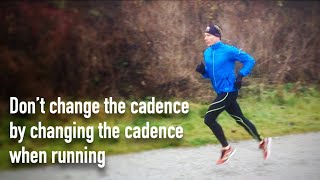
Understanding Running Cadence
Today we are talking about all things related to running efficiency, starting with your cadence. Cadence, or stride rate, refers to the number of steps you take per minute (SPM). While the "magic number" of 180 steps per minute is often cited as the gold standard for elite athletes, the reality is that optimal cadence is highly individual. It depends on your height, limb length, running speed, and natural biomechanics.
Improving your cadence is one of the most effective ways to reduce impact forces on your joints and improve overall running economy. When you increase your steps per minute, you generally decrease your ground contact time and reduce the tendency to overstride. Overstriding—landing with your foot far in front of your center of mass—acts as a braking force and increases the load on your knees and hips. By focusing on a quicker turnover, you bring your feet closer to your center of gravity, promoting a more efficient gait.
How to Measure Your Current Stride Rate
Before you attempt to change your mechanics, you need a baseline. Measuring your cadence is straightforward. During a steady-state run, count how many times your right foot hits the ground in 30 seconds. Multiply that number by four to get your total steps per minute for both feet. Modern running watches and wearable sensors can also provide this data automatically. Once you know where you stand, you can implement gradual changes to improve your form.
Practical Strategies to Increase Cadence
You should never attempt to jump from a low cadence to a high one overnight, as this can increase the risk of soft tissue injuries. Instead, focus on incremental improvements. Here are several proven methods to help you increase your running cadence safely:
1. Use a Metronome
The most direct way to train your legs to move faster is by using a metronome. There are various smartphone apps that allow you to set a specific beats-per-minute (BPM) rate. Start by finding your current cadence and increasing it by only 5% to 10%. If you currently run at 160 SPM, aim for 168 SPM. Set your metronome to this target and try to synchronize your foot strikes to the beat. This auditory cue helps your brain internalize the rhythm until it becomes second nature.
2. Incorporate Specific Running Drills
Drills are essential for developing the neuromuscular coordination required for a faster turnover. Focus on exercises that emphasize short ground contact time and high knee drive. High knees, butt kicks, and A-skips are excellent for teaching your body to cycle your legs more efficiently. Incorporating these into your warm-up routine three times a week can significantly improve your mechanics over time.
3. Focus on Short, Quick Steps
Instead of thinking about "running faster," focus on "running lighter." Imagine you are running on hot coals or fragile glass. By consciously trying to make less noise when your feet hit the pavement, you naturally shorten your stride and increase your cadence. Aim to keep your feet landing underneath your hips rather than reaching out in front of you.
4. Improve Mobility and Strength
Sometimes, a low cadence is a result of limited range of motion. If your hips are tight, your stride length is restricted, or your body may compensate with inefficient movement patterns. Incorporating mobility work, such as the routines found in the GOWOD app, can help improve hip extension and ankle flexibility. Additionally, strength training—specifically exercises that target your glutes, hamstrings, and calves—provides the power needed to maintain a higher turnover without premature fatigue.
The Role of Professional Guidance
Improving your running form is a journey that often requires expert insight. Experts like Brodie Sharpe, host of the Run Smarter podcast, emphasize that form changes should be sustainable and pain-free. If you find that changing your cadence leads to discomfort, it is important to slow down your progression or consult with a physical therapist or running coach. They can perform a gait analysis to determine if your low cadence is caused by a specific muscular weakness or an imbalance that needs to be addressed