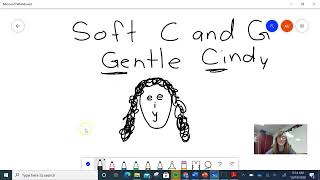
Understanding Gentle Cindy: Mastering Soft C and G Sounds
For early learners and students of English, the alphabet often seems straightforward until they encounter letters that change their sounds based on the letters surrounding them. One of the most common challenges in phonics is distinguishing between "hard" and "soft" consonants, specifically the letters C and G. To make this concept accessible, educators often use the mnemonic Gentle Cindy.
Gentle Cindy is a teaching tool designed to help students decode and spell words with soft C and G sounds confidently. By associating these sounds with a character or a specific rule, students can move beyond rote memorization and begin applying linguistic patterns to their reading and writing.
What is the "Soft C" and "Soft G" Sound?
In English phonics, the letters C and G are versatile. Most students first learn the "hard" sounds: the /k/ sound in cat and the /g/ sound in goat. However, these letters shift their pronunciation when they are followed by specific vowels.
- Soft C: When the letter C is followed by e, i, or y, it typically makes the /s/ sound. Examples include cent, city, and fancy.
- Soft G: When the letter G is followed by e, i, or y, it often makes the /j/ sound. Examples include gem, giant, and gym.
The phrase "Gentle Cindy" serves as a reminder of these "gentle" sounds. While the hard sounds are percussive and strong, the soft sounds are smoother, which is why the term "gentle" is used to categorize them.
Implementing Gentle Cindy in the Classroom
Integrating the concept of Gentle Cindy into a curriculum requires a structured approach. According to principles of the Science of Reading (SoR), students benefit most from explicit instruction and systematic mapping of words.
1. Introduction and Comparison
Before introducing soft sounds, ensure students have mastered the hard sounds. A common instructional path involves reviewing the hard sound of C (as in cup) and then introducing the soft sound (as in cell) side-by-side. This contrast helps students recognize the shift in pronunciation.
2. The Role of Vowels
The key to the Gentle Cindy rule is the vowel that follows the consonant. Educators often use phonics songs or visual charts to highlight that e, i, and y are the "trigger" letters. When students see a C or G followed by one of these three vowels, they are trained to anticipate the soft sound.
3. Word Mapping and Blending
To move from recognition to production, students should engage in mapping words. This involves breaking a word down into its individual phonemes (sounds) and connecting them to the corresponding graphemes (letters). For example, when spelling city, a student identifies the /s/ sound and remembers that because it is followed by an 'i', they should use a 'C' rather than an 'S'.
Who Should Learn This Pattern?
While phonics is a cornerstone of early education, timing is essential. Educators generally advise that soft C and G patterns are not introduced to kindergarteners unless they are advanced and have already mastered basic consonant-vowel-consonant (CVC) patterns. Introducing complex rules too early can lead to confusion; therefore, Gentle Cindy is typically introduced in first or second grade, or during targeted intervention for older students struggling with decoding.
Tips for Parents and Educators
To reinforce the Gentle Cindy rule at home or in the classroom, consider the following strategies:
- Sound Hunts: Give students a magazine or a book and ask them to find five words where C sounds like /s/ and five where it sounds like /k/.