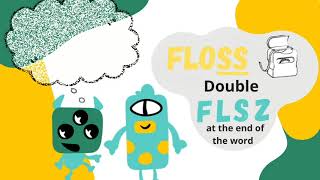
Understanding the Floss Rule Anchor Chart for Early Literacy
Teaching early readers how to spell can be challenging, especially when they encounter words that don't follow basic phonetic patterns. One of the most effective tools for simplifying this process is the Floss Rule Anchor Chart. This visual aid helps students recognize a specific pattern in one-syllable words, reducing spelling errors and building confidence in young writers.
What is the Floss Rule?
The Floss Rule is a spelling guideline used to determine when to double the final consonant in a short-vowel word. While the name "Floss" comes from the word floss itself, the rule applies to more than just the letter 's'.
Specifically, the rule states: If a one-syllable word ends with a single short vowel followed by the letters f, l, s, or z, you double the final consonant.
Common examples include:
- f: Cliff, stiff, snuff
- l: Bell, hill, doll
- s: Grass, mess, loss
- z: Buzz, jazz, fizz
Why Use an Anchor Chart?
An anchor chart serves as a permanent visual reference in the classroom or at home. For children in the early stages of reading and writing, relying solely on memory can be overwhelming. An anchor chart "anchors" the learning by providing a constant reminder of the rule.
By using a Floss Rule Anchor Chart, educators can:
- Provide Immediate Support: Students can glance at the chart during independent writing rather than asking the teacher for every word.
- Reinforce Pattern Recognition: Seeing the letters f, l, s, and z grouped together helps children recognize the visual pattern.
- Encourage Self-Correction: When a student writes "bel" instead of "bell," they can use the chart to check if the word fits the Floss Rule criteria.
How to Create an Effective Floss Rule Anchor Chart
To make the most of this tool, the chart should be colorful, clear, and interactive. Here are the essential elements to include:
1. A Clear Title
Start with a bold title like "The Floss Rule" or "Double the Final Consonant." Using a picture of dental floss next to the title can provide a mnemonic device to help children remember the name of the rule.
2. The "Checklist" Criteria
Instead of writing a long paragraph, use a checklist format. This teaches children the logical steps to determine if the rule applies:
- Is it a one-syllable word?
- Does it have a short vowel?
- Does it end in f, l, s, or z?
3. Visual Examples
Divide the chart into four sections—one for each letter. Include a simple illustration next to the word to support English Language Learners (ELL) and struggling readers. For example, draw a small bell next to the word bell or a blade of grass next to grass.
4. The "Exceptions" Section
No spelling rule is perfect. It is helpful to include a small section for "Rule Breakers" or "Heart Words." Words like bus, gas, yes, and if do not follow the Floss Rule. Marking these as special words helps children understand that while patterns exist, some words simply must be memorized.
Integrating Multi-Sensory Learning
An anchor chart is most effective when paired with other instructional methods. To truly cement the Floss Rule in a child's mind, consider these additions:
The Floss Rule Chant: Incorporating a rhythmic chant or song allows children to use auditory learning.