Understanding Factor Rainbows: A Simple Guide for Students
Learning how to break down numbers is a fundamental part of 4th grade math. One of the most effective visual tools for mastering this concept is the Factor Rainbow. This method helps students identify all possible factor pairs for a given number, ensuring that no combinations are missed during the process of multiplication and division practice.
What are Factors?
Before diving into the rainbow method, it is essential to understand what factors are. Factors are numbers that you multiply together to get another number. For example, if you multiply 2 and 3, you get 6. Therefore, 2 and 3 are factors of 6. Since 1 times 6 also equals 6, 1 and 6 are also factors.
Finding factors is essentially the opposite of multiplication. While multiplication combines small numbers to create a larger product, factoring breaks a large number down into the smaller numbers that built it. This skill is critical for simplifying fractions and understanding prime and composite numbers.
How to Create a Factor Rainbow
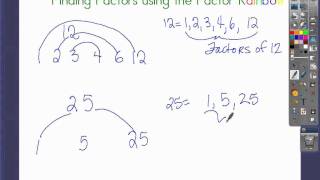
A factor rainbow is a visual model used to work out the factor pairs of a number. By drawing arcs (the "rainbows") to connect pairs, students can keep their work organized and verify that they have found every possible pair.
Here is a step-by-step guide on how to use this model:
- Start with One: Every number is divisible by 1 and itself. Write 1 at the far left of your workspace and the target number at the far right. Draw an arc connecting them.
- Move to Two: Check if the number is even. If it is, divide the target number by 2 to find its partner. Write 2 next to the 1, and write its partner next to the target number. Draw an arc connecting them.
- Test Sequential Numbers: Continue testing numbers in order (3, 4, 5, etc.). If the target number can be divided evenly by the test number without a remainder, you have found a factor pair.
- Close the Gap: Continue this process until the numbers meet in the middle or begin to repeat. Once there are no more whole numbers between your last pair, your rainbow is complete.
Example: Finding Factors of 24
To illustrate this, let's work out the factors of 24 using the rainbow method:
- Pair 1: 1 and 24 (1 × 24 = 24)
- Pair 2: 2 and 12 (2 × 12 = 24)
- Pair 3: 3 and 8 (3 × 8 = 24)
- Pair 4: 4 and 6 (4 × 6 = 24)
By listing these in order (1, 2, 3, 4, 6, 8, 12, 24) and connecting them with arcs, the student creates a visual representation that confirms all factor pairs have been identified.
Why Use Visual Models in Math?
Math for kids can often feel abstract. Using models like factor rainbows transforms a mental calculation into a physical activity. This approach is particularly beneficial for several reasons:
- Prevents Omissions: It is common for students to forget a pair (like 3 and 8 in the example above). The sequential nature of the rainbow ensures every possibility is tested.
- Reinforces Multiplication and Division: To complete a rainbow, a student must use both multiplication (to check the pair) and division (to find the partner).
- Pattern Recognition: Students begin to notice patterns, such as how even numbers always have 2 as a factor, or how numbers ending in 0 or 5 always have 5 as