Mastering Distance on the Coordinate Plane Worksheets
Understanding how to calculate the distance between two points is a fundamental skill in coordinate geometry. Whether you are a student preparing for a standardized test or a teacher looking for effective classroom materials, distance on the coordinate plane worksheets provide the structured practice necessary to master this concept.
The primary objective of these lessons is to enable students to use specific mathematical formulas and logical reasoning to determine the exact length between any two coordinates on a grid. By practicing with diverse problem sets, learners can move from simple horizontal and vertical distances to more complex diagonal measurements.
Understanding the Basics of the Coordinate Plane
Before diving into complex worksheets, it is essential to understand the environment. The coordinate plane consists of two perpendicular lines: the x-axis (horizontal) and the y-axis (vertical). Every point is represented as an ordered pair (x, y).
A critical building block for finding distance is the concept of absolute value. As taught in foundational geometry lessons, the absolute value of a number represents its distance from zero on a number line, regardless of direction. This is vital when calculating distances because length can never be negative.
Calculating Horizontal and Vertical Distance
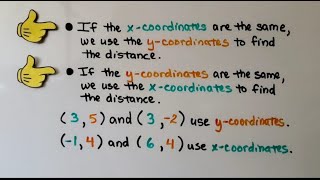
The simplest distance problems involve points that lie on the same line. When points share a coordinate, you do not need complex formulas; you only need to find the difference between the coordinates that change.
- Horizontal Distance: If two points have the same y-coordinate, subtract the x-coordinates and take the absolute value.
- Vertical Distance: If two points have the same x-coordinate, subtract the y-coordinates and take the absolute value.
For example, to find the distance between (2, 3) and (7, 3), you simply calculate |7 - 2|, resulting in a distance of 5 units.
Finding the Distance Between Any Two Points
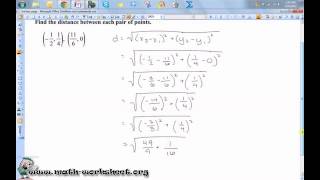
When points are not aligned horizontally or vertically, they create a diagonal line. To figure out the distance in these scenarios, we utilize the Distance Formula, which is a derivation of the Pythagorean Theorem.
The formula is expressed as: d = √((x₂ - x₁)² + (y₂ - y₁)² )
To successfully complete worksheets involving this formula, students should follow these steps:
- Identify the Coordinates: Label your points as (x₁, y₁) and (x₂, y₂).
- Subtract the Coordinates: Find the difference between the x-values and the difference between the y-values.
- Square the Differences: Square both results to ensure the numbers are positive.
- Sum the Squares: Add the two squared values together.
- Find the Square Root: Take the square root of the sum to find the final distance.
The Value of Targeted Practice Worksheets
Using dedicated worksheets allows students to build "muscle memory" for these calculations. High-quality distance on the coordinate plane worksheets typically include a progression of difficulty:
- Guided Practice: Problems that provide step-by-step scaffolding.
- Visual Problems: Points plotted on a grid where students can visually verify their answers.
- Abstract Problems: Coordinate pairs provided without a grid to encourage reliance on the formula.
- Real-World Applications: Word problems that ask students to find the distance between two "cities" mapped on a coordinate plane.
Tips for Improving Accuracy
Many students make common errors when working through coordinate geometry. To improve accuracy, keep these tips in mind:
Always double-check signs: When subtracting a negative coordinate, remember that it becomes addition (e.g., 5 - (-3) = 8).
Don't forget the square root: A common mistake is to