Understanding Compare and Contrast Text Structure
When reading a text, understanding how the author organizes information is key to comprehension. One of the most common organizational patterns is the compare and contrast text structure. This method allows writers to examine two or more subjects to highlight their similarities and differences, providing the reader with a clearer understanding of how the subjects relate to one another.
What is Compare and Contrast Text Structure?
At its core, comparing means identifying how two or more things are alike, while contrasting means identifying how they are different. When an author uses this text structure, they are not simply listing facts; they are analyzing the relationship between subjects to draw a conclusion or provide a detailed evaluation.
This structure is widely used in academic writing, scientific reports, and literary analysis. For example, a science textbook might compare and contrast plant cells and animal cells, while a history book might analyze the differences and similarities between two ancient civilizations.
Common Signal Words
To identify a compare and contrast structure, readers should look for specific "signal words." These keywords act as clues that the author is shifting between similarities and differences.
Words Used for Comparing (Similarities)
- Similarly: Used to introduce a shared characteristic.
- Likewise: Indicates that the same logic applies to another subject.
- Both: Explicitly connects two subjects.
- Also: Adds another similar trait.
- In the same way: Shows a parallel between two ideas.
Words Used for Contrasting (Differences)
- However: Signals a shift to a differing point.
- On the other hand: Introduces a contrasting perspective.
- Unlike: Directly highlights a difference between two items.
- Whereas: Used to compare two different facts in one sentence.
- Conversely: Indicates an opposite or contrary idea.
Two Primary Ways to Organize the Text
Authors generally choose one of two methods when writing a compare and contrast essay or paragraph: the point-by-point method or the block method.
1. The Point-by-Point Method
In this approach, the author discusses one specific feature (a point) and explains how it applies to both subjects before moving on to the next feature. This method is often preferred for longer, more complex pieces because it keeps the comparison tight and easy to follow.
Example: If comparing two smartphones, the author would first discuss the battery life of both phones, then the camera quality of both phones, and finally the price of both phones.
2. The Block Method
The block method involves discussing all the characteristics of the first subject entirely, and then discussing all the characteristics of the second subject. The author must ensure that the points discussed for the second subject mirror those discussed for the first to maintain a logical flow.
Example: The author would write one full paragraph about Smartphone A (battery, camera, price), followed by one full paragraph about Smartphone B (battery, camera, price).
How to Analyze Compare and Contrast Texts
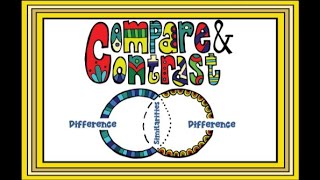
To better understand these texts, students and readers can use a Venn Diagram. By placing the two subjects in overlapping circles, the outer sections can be used to list unique characteristics (contrasting), while the overlapping center section is used for shared traits (comparing).
When analyzing the text, ask yourself the following questions:
- What are the two or more subjects being discussed?
- Which signal words indicate a similarity?
- Which signal words indicate a difference?
- Does the author seem to favor one subject over the other?
Why This Structure Matters
Learning how to recognize and use compare and contrast text structure improves critical thinking.