Mastering Mathematical Terms with an Algebra Word Search
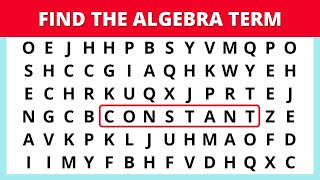
Learning mathematics often involves memorizing a vast array of specialized vocabulary. For students diving into Algebra, the transition from basic arithmetic to symbolic reasoning introduces a new language of variables, coefficients, and functions. One of the most effective ways to reinforce this terminology without the stress of a formal exam is through an Algebra Word Search.
Combining a word game with educational content helps learners associate visual patterns with mathematical concepts. Whether you are a student looking to study or a teacher designing a classroom activity, integrating a word search into the curriculum can make the learning process more engaging.
Why Use Word Searches for Learning Algebra?
While solving equations is the primary goal of algebra, understanding the language used to describe those equations is a critical first step. A word search serves as a cognitive bridge, helping students recognize key terms before they apply them in complex problems. Here are a few benefits of this approach:
- Vocabulary Reinforcement: Repeatedly searching for terms like Polynomial or Quadratic helps cement the spelling and recognition of these words.
- Stress Reduction: Gamifying the learning experience reduces "math anxiety," allowing students to interact with the subject in a low-pressure environment.
- Pattern Recognition: Algebra is essentially the study of patterns. Searching for a hidden word in a grid of letters mirrors the analytical scanning required to find patterns in algebraic expressions.
Essential Algebra Terms to Include
If you are creating your own puzzle, you want to ensure a balance of basic and advanced terms. Depending on the level of the student, you can categorize your word list to target specific learning objectives.
Basic Algebra Terms
For beginners, focus on the foundational building blocks of the subject:
- Variable: A symbol, usually a letter, used to represent an unknown number.
- Constant: A value that does not change.
- Coefficient: The number that multiplies a variable.
- Expression: A mathematical phrase containing numbers, variables, and operators.
- Equation: A statement that two expressions are equal.
Intermediate and Advanced Terms
For those moving into Algebra I or II, include more complex concepts to challenge their knowledge:
- Parabola: The U-shaped curve created by a quadratic function.
- Inequality: A mathematical statement comparing two values using symbols like < or >.
- Exponent: A quantity representing the power to which a number is raised.
- Binomial: A polynomial with exactly two terms.
- Slope: The measure of the steepness of a line.
How to Create Your Own Online Algebra Word Search
In the digital age, you no longer need to draw grids by hand. You can learn how to create online puzzles using various free generator tools. To make an effective educational puzzle, follow these steps:
- Define Your Objective: Decide if the puzzle is for an introduction to the unit or a review before a final test.
- Curate Your Word List: Select 15 to 20 words. Too few make the game too easy; too many can make the grid overwhelming.
- Choose Your Difficulty: Decide if words should only be horizontal and vertical, or if you want to include diagonals and backwards words for an extra challenge.
- Add a Definition Component: To increase the educational value, instead of providing a list of words to FIND, provide the definitions and ask the students to determine the word themselves before searching the grid.
Connecting Algebra to Coding and Logic
The logic found in algebra is the foundation of computer science. Many students who enjoy the puzzle-solving aspect of an algebra word search often find they have a natural aptitude for programming. The process of breaking down a





![[ASMR] Sleepy, Relaxing Word Search with Math-Related Words (quiet whispers, writing, paper) ~1hr](https://i.ytimg.com/vi/UGi3JDAd1Qk/mqdefault.jpg)

